
The Future of Work
AI-powered individuals doing more with less
Teams are getting smaller and moving faster. Individuals are operating across functions using AI to close knowledge and skills gaps. This is the way the future of work is headed, whether we like it or not.
How are you shaping your people to thrive in tomorrow’s world?

Exploring AI Opportunities
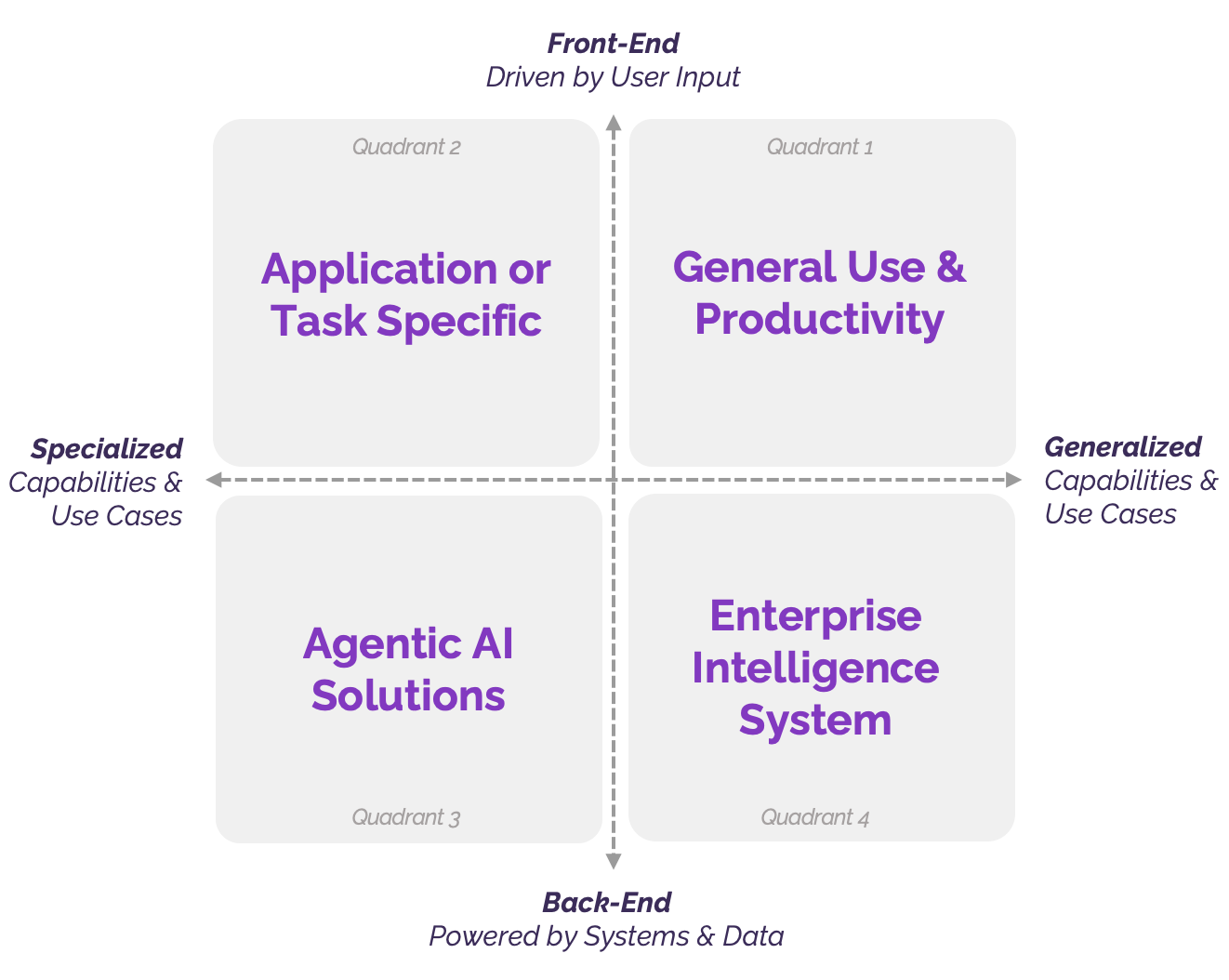
AI presents a wide range of opportunities, but not every tool or approach is right for every organization. We help you explore where AI can realistically support your business today, assess what’s feasible, and determine the right path forward based on your priorities, capabilities, and operating model.
Our approach helps organizations move from exploration to action—grounded in reality, not hype.
-
Understand how AI is currently being used across your organization, including tools, informal workflows, and emerging use cases.
This is paired with current-state process and systems mapping to make work explicit, identify dependencies, and establish a baseline that supports deconstructing existing processes and reconstructing them with AI where it creates the most value.
-
Evaluate potential AI use cases against feasibility, risk, data readiness, and expected impact. This helps prioritize initiatives that are realistic, valuable, and aligned with your operating environment.
-
Rapidly test and validate AI ideas through structured proof-of-concepts. This approach enables informed decision-making, validates foundational components, and establishes readiness to evolve promising concepts into scalable AI pilots.
Setup & Execute Your AI Pilots
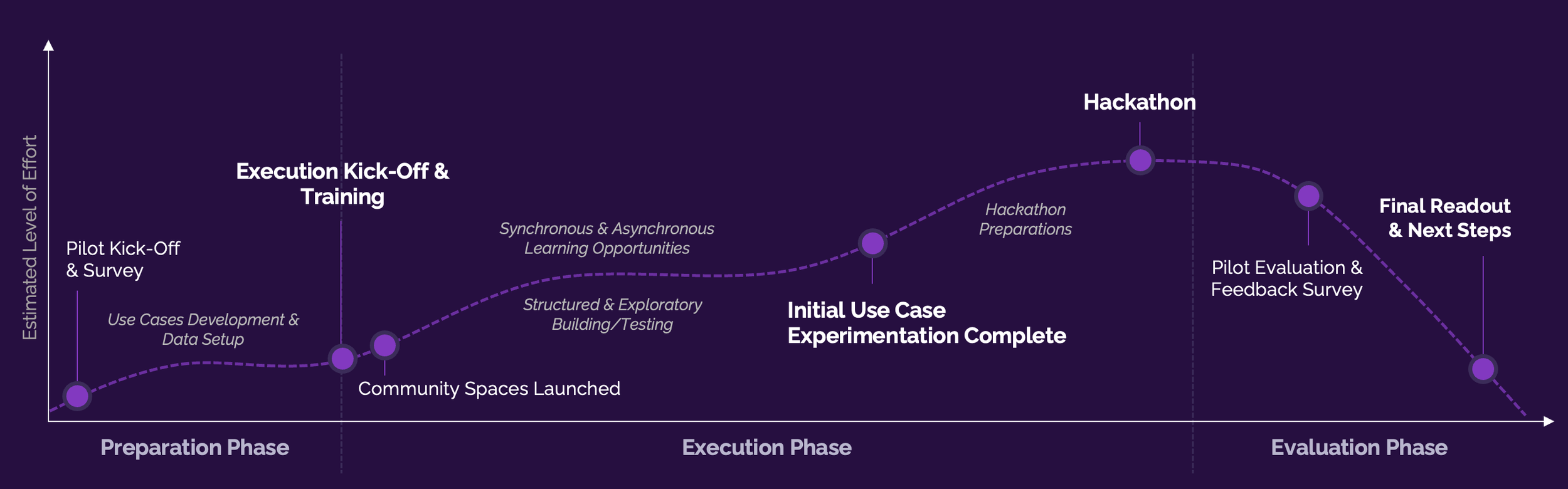
Week 0: Kick-Off & Pre-Survey
Attend kick-off meeting.
Review a small curation of content covering AI basics.
Take a short survey on AI fluency and goals.
Weeks 1 & 2: Project Preparations
Select 1-2 workflows to explore during the project.
Finalize your AI stack to build and test.
Create current-state baseline metrics.
Assess AI usage within workflows & prep data.
Weeks 3-7: Build & Test
AI Tool Customization and Workflow Development
Foundational Learners will spend the entire 5 weeks on prompt engineering and customizing AI tools. Advanced Learners will begin exploring automations and agents.
All pilot participants will attend a full day hackathon to conclude the build/test phase.
Playbook Development
The Project Violet team will begin drafting and reviewing the playbook with the pilot group each week using content from the working sessions.
Week 8: Finalize Deliverables
Consolidate lessons learned & reviews of AI tools used in the community.
Publish the final prompt library for each community group.
Share the final editable version of the Champions Network playbook with processes and templates used during the AI Pilot.
Tangible Outcomes & Deliverables
All work conducted during the AI pilot is consolidated into a set of reusable, editable assets your teams can immediately apply and extend. These deliverables are designed to support continued adoption, scale successful patterns, and reduce friction as AI moves into core operations.
-
A curated, role- and workflow-specific prompt library built from real pilot usage.
Prompts are documented, refined, and ready to be reused, adapted, and expanded across teams.
-
Configured AI tools and end-to-end workflows tailored to your operating environment.
These assets reflect real constraints, data considerations, and governance requirements tested during the pilot.
-
A structured pipeline of AI use cases identified and refined during the pilot.
Use cases are categorized from quick wins to more complex opportunities that may evolve into larger projects or strategic initiatives, providing a clear path from experimentation to investment.
-
A practical playbook capturing the operating model, processes, templates, and lessons learned from running the pilot.
This serves as a blueprint for expanding AI efforts beyond the initial team.

Learning in Community to Drive AI Adoption
We believe sustainable AI adoption is driven by learning in community. Project Violet helps organizations design Champions Networks and shared learning structures that transform AI experimentation into scalable, operational capability.
This approach builds a culture of learning and sharing that accelerates adoption and embeds AI into core operations.
Community Spaces for Shared Knowledge:
-
We help organizations create structured spaces for teams to surface, refine, and prioritize AI use cases grounded in real work.
This enables faster identification of high-value opportunities and prevents AI efforts from fragmenting into disconnected experiments.
-
We establish shared prompt libraries and learning loops that improve prompt quality over time.
Teams learn from each other’s successes, reduce duplication, and develop consistent prompt patterns that can be reused across roles and workflows.
-
We support teams in evaluating, configuring, and pressure-testing AI tools within defined guardrails.
Learnings from hands-on usage are captured and shared to inform tooling standards, integration decisions, and future platform investments.
-
We help teams break down end-to-end workflows and identify where AI can assist, augment, or automate work.
These workflows are refined in community and documented as repeatable patterns that can be scaled across the organization.

From AI Pilots to Enterprise Enablement
Running a successful AI pilot is only the first step. True value is realized when learning, governance, tooling, and operating models come together to support adoption at scale.
Our AI Enablement whitepaper outlines the principles, structures, and decisions required to move from experimentation to enterprise capability..
Get in touch.
Interested in equipping your teams for the future of work? Our AI Upskilling and AI Enablement programs are designed to build real-world fluency through hands-on learning, prompt engineering, and workflow automation.
Get in touch to explore how we can customize a learning journey that aligns with your tools, your teams, and your transformation goals.